The Quietest House in the World
The history of our relationship with Magnolia, a sixty-pound Pit Bull mix with eyes that seemed to hold a century of sorrow, was a chronicle of repeated heartbreak and structural failure. We had attempted everything within the scope of modern veterinary medicine and behavioral science, including hiring a high-level specialist named Dr. Evelyn Thorne to analyze the case. Dr. Thorne spent forty-eight hours at our facility, observing Magnolia through the glass and taking meticulous notes on the way the dog interacted with the staff and the environment. She eventually sat me down in my cramped, paper-strewn office to deliver a verdict that felt more like a sentence than a diagnosis.
“Celia, what you are looking at is a profound case of separation-induced panic that has been accidentally conditioned over years of human intervention,” Dr. Thorne explained while she adjusted her spectacles. “Every single time Magnolia begins her vocalization at night, the humans in her vicinity react with an intensity that mirrors her own. They scream at her to be quiet, or they sit on the floor and weep alongside her, or they lock her in a crate, or—most damagingly—they decide they cannot handle the emotional weight and they bring her back to you. Magnolia has learned a very specific, very terrifying equation: her voice is the only thing that predicts the moment her world is about to disappear, so she uses that voice with increasing desperation to keep the abandonment at bay.”
A Diagnosis of Silence
I asked her, with a weariness that felt bone-deep, what possible solution remained after six failed adoptions and years of behavioral therapy. Dr. Thorne was silent for a long moment, staring out the window at the play yard where Magnolia was currently pacing the fence line with a frantic, rhythmic energy.
“To be perfectly honest, Celia, the only way to break this loop is to find an adopter who is physically incapable of responding to the sound,” she said, her voice dropping to a low, serious register. “You would need someone who simply cannot hear her, because every single reaction—even the ones rooted in the deepest kindness—only serves to confirm her fear that her howling is the only thing standing between her and the void.”
I let out a short, hollow laugh, assuming she was speaking in metaphors, but she did not join me in my cynical amusement. She insisted that Magnolia needed to learn that silence was just as safe as a scream, and that the only way to facilitate that unlearning was through a human whose biological reality made reactivity an impossibility. I went home that night and sat in the dark, wondering how one goes about searching for a person who lives in a world where sound does not exist, yet who possesses a heart large enough to accommodate a dog that everyone else had discarded.
The Man from the Coast
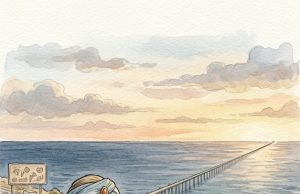
The answer arrived a week later in the form of a man named Julian Vance, who walked into the shelter carrying a worn leather satchel and a sense of stillness that seemed to settle the air around him. Julian was in his late fifties, a master woodworker who crafted bespoke furniture in a small studio overlooking the jagged cliffs of the Oregon coast. He was a man of significant physical presence, with silver-streaked hair and hands that bore the honorable scars of his trade.
Julian was also profoundly deaf, having lost his hearing to an illness in early childhood, and he moved through the world with a fluid, observant grace. He wore a hearing aid for his professional interactions, but he made it clear on his application that he preferred total silence when he was at home. He read lips with a focused intensity that made you feel as though he were reading your very thoughts, and when he spoke, his voice was soft and lacked the jagged edges of those who grow up surrounded by noise.
On his application, under the section regarding his motivation for adoption, he had written a single, poignant sentence: My home has become a place where the silence is too heavy, and I am looking for a companion who needs a sanctuary as much as I do. I looked at Julian, and then I looked at the behavioral report on my desk, and I felt a strange, cold shiver of possibility. I decided then and there that despite the risks, I would introduce him to Magnolia.
The First Meeting of Hands
When we walked back to the kennels, Magnolia was curled in the far corner of her space, her head tucked beneath her tail in a posture of total defeat. Julian did not approach the gate with the usual high-pitched coaxing of most visitors; instead, he knelt slowly on the concrete floor and waited. He didn’t make a sound, but he began to move his hands in a slow, rhythmic series of signs, a silent language that Magnolia watched with an inquisitive tilt of her blocky head.
He told me later that he had simply introduced himself and promised her that he was not afraid of whatever shadows she was carrying. Magnolia eventually rose, her tail giving a tentative, low-slung wag, and she pressed her damp nose against the chain-link fence. Julian placed his palm flat against the metal, and for a long minute, they simply breathed in the same rhythm.
“Celia, I think we have spent our lives preparing for this specific moment,” Julian said in his flat, gentle tone after I explained the history of her vocalizations and the warnings from Dr. Thorne. He looked at Magnolia, and she looked back at him with a gaze that finally seemed to find a place to rest. He took her home that Saturday in the back of his old Volvo, and as I watched them drive away, I felt a mixture of hope and terror that kept me awake for the rest of the weekend.
The Architecture of Non-Reaction
The first night in the coastal cottage was a test of the laws of physics and psychology. At exactly eleven o’clock, Julian performed his nightly ritual: he turned off the lamps, removed his hearing aid, and placed it on the mahogany nightstand he had built himself. The world became a vacuum of absolute quiet, and he climbed into bed, falling into the deep, undisturbed sleep of a man who does not expect to be interrupted. Magnolia was settled in the living room on a plush velvet cushion, the ocean breeze whistling through the cracks in the window frames.
At 11:34 p.m., the panic reached its peak, and Magnolia began to howl. It was the sound that had ended six other lives—a long, agonizing, subterranean wail that vibrated through the very foundation of the house. In any other home, a light would have flickered on; a door would have been thrown open; a frustrated voice would have shouted a command. But in Julian’s house, nothing changed. The darkness remained thick and unbroken. The man in the other room did not stir.
According to the security footage Julian later shared with me, Magnolia howled for three hours and twenty-two minutes without a single second of pause. She screamed at the silence, demanding a reaction that never came. Around 3:00 a.m., she finally stopped, her chest heaving with exhaustion. She stood up, walked tentatively down the hallway, and pushed open the bedroom door. She found Julian sleeping peacefully, his face softened by rest, completely unaware of the storm that had just raged ten feet away.
The Loudest Silence
Magnolia stood by the edge of the mattress for a long time, watching the rise and fall of his chest. Then, with a caution that was almost heartbreaking to witness, she hopped onto the bed and curled herself into a tight circle at the foot of the comforter. When Julian woke up at dawn, he found sixty pounds of sleeping dog resting against his shins.
“Celia, it was the most beautiful thing I have ever seen on a screen,” Julian told me during our first follow-up visit a month later. “I watched the video of her realizing that her voice had no power over my presence. She screamed until she had nothing left, and when she finally came to find me, she discovered that the world hadn’t ended. I wasn’t gone. I wasn’t angry. I was just there, waiting for the morning.”
Dr. Thorne’s theory had been correct: Julian hadn’t needed to be a trainer or a magician. He simply had to be a person for whom the sound did not exist. Because he could not hear her, he could not accidentally confirm her trauma. He provided the only thing Magnolia had ever truly needed: a pure, unadulterated non-reaction that allowed her to finally lay down her burden.
A Sanctuary of Motion
I visited them at the cottage six months later, and the transformation was nothing short of miraculous. The frantic, vibrating energy that had once defined Magnolia had been replaced by a structural, grounded calm. She no longer paced the perimeter of her life; she moved with a slow, contented ease that mirrored Julian’s own.
The house smelled of cedar and salt air, and the only sound was the crashing of the waves against the shore. Julian sat at his workbench, and Magnolia lay in a patch of sunlight on the wood-shavings-covered floor. He had taught her a library of hand signals, and she responded to the motion of his fingers with a precision that was breathtaking.
“She still vocalizes sometimes during the day,” Julian signed to me, his hands moving through the air like birds. “I can feel the vibration through the soles of my feet when I am working at the lathe. But I never look at her when she does it. I just keep working, letting her know that her voice is just a sound, and that it doesn’t change the fact that I am her person and she is mine.”
The Language of Vibration
He told me that he believes Magnolia finally understood that she didn’t have to scream to keep him close. She had spent her whole life trying to use noise to tether people to her, only to discover that the strongest bond was forged in the absolute quiet of a man who stayed because he wanted to, not because he was being yelled into submission.
“I didn’t fix her, Celia,” Julian said as we watched Magnolia chase a shadow across the porch. “I just provided a house where the worst thing she could imagine—being ignored—turned out to be the very thing that set her free. She learned that I stay even when she is silent, and that changed everything.”
It has been three years now, and Magnolia is a fixture of that coastal town, a dog known for her immense patience and her deep, unshakeable bond with the man in the woodworking shop. They move through the world in a silent choreography of trust, a testament to the idea that sometimes, the best way to hear someone is to stop listening to the noise and start paying attention to the heart.
The Lesson of the Coastal Wind
Dr. Thorne eventually published a paper on the case, focusing on the therapeutic power of sensory-neutral environments for trauma recovery in animals. She didn’t name Julian, but she wrote about the profound impact of an adopter whose neurology acted as a natural barrier to the cycle of anxiety.
I keep a copy of that paper in my desk, but I rarely read the clinical parts. Instead, I think about Julian’s hands moving in the air, signing I love you to a dog that finally found a place where she didn’t have to shout to be seen. I think about the fact that Magnolia didn’t need to be retrained; she just needed to be loved by someone who lived in a world where her trauma had no voice.
In the end, it wasn’t the medicine or the behavioral loops that saved her. It was a house by the sea, a man with silver hair, and the loudest, most healing silence in the world.
If there was ever a person who stayed when you were sure you were too loud to be loved, remember that sometimes, the quietest hearts are the ones that hear us best.