Every afternoon at 5 o’clock, a dog would steal a flower from the cemetery. The animal would walk past the trash without looking at it. It ignored the bones, the remains, anything that smelled of food. One flower, just one. Vicente had seen it on the security cameras and couldn’t believe it. It would walk straight toward the flowers. It would sniff them slowly, one by one, as if searching for something specific.
He chose only one. He took it with a gentleness strange for a stray animal and walked away without running, without hiding. Vicente rubbed his eyes in front of the monitor. That dog had a destiny. That was the only thing he was sure of. That afternoon, Vicente waited for him, hidden behind the largest gravestone at the entrance. And when the dog appeared, thin, with one leg dragging slightly, he took his white rose with his usual calm. Vicente didn’t shout because something about that animal left him speechless.
Vicente had worked at the Guadalupe municipal cemetery for 22 years. He knew every tombstone, every date, which graves received visitors and which had gone months without anyone approaching them. It was his territory, and he cared for it as such. That’s why, when the flowers started to disappear, he noticed it immediately.
At first, he thought it was the crows. After some neighbors were seen taking other people’s arrangements to decorate their own homes, he checked the entrances and spoke with the other employees. No one had seen anything unusual, but the flowers kept disappearing, always white roses, one a day from the same area, the one closest to the main avenue, where wealthier families left the largest arrangements. Vicente started keeping count in a small notebook, one of those with a cardboard cover that you can buy at any neighborhood stationery store.
In three weeks the list had 19 entries, 19 roses, one per day. Someone or something knew exactly what he was doing. The answer came one Tuesday when he finally reviewed the recordings from the camera facing the north side of town. The image was black and white, grainy, with the time marked in the lower corner: 5:04 p.m. And there was a skinny dog with golden-yellow fur, dulled by dust and the street, one hind leg moving differently than the others.
He walked slowly among the graves as if he knew the place. He stopped in front of the Mondragón family’s arrangement, the largest that week, with two dozen white roses freshly placed that morning. What Vicente saw next made him tilt his head toward the monitor. The dog sniffed at them one by one calmly, without haste, until he found the one he was looking for. He picked it carefully, the stem between his teeth, petals facing upward, and walked toward the side gate.
Vicente tightened his grip on the back of his chair. A dog. All this time. A damn dog. His first impulse was to go talk to the municipal official and ask them to call animal control. That was the right thing to do. A loose animal inside the cemetery was a health hazard, in addition to the damage to property. He picked up his phone, then put it back on the desk. Something in that recording wouldn’t let him close the matter like that. He kept thinking about the way the animal had chosen the flower, that care that made no sense for a stray dog looking for food or shelter.
What did he want the rose for? The next day, Vicente arrived 40 minutes earlier than usual. He positioned himself behind the Resendis family’s gray marble gravestone, the largest and widest in the area, with a direct view of the floral arrangements. He carried his thermos of black coffee and the glasses he normally only used for reading. He waited. At 5:02 p.m., the dog entered through the side gate. Up close, it was thinner than it appeared on camera.
His ribs showed through his fur. He had an old scar above his right eyebrow. He placed his left hind paw carefully, as if the ground hurt him slightly depending on where he stepped. He walked past a trash bag someone had left near the path. He didn’t even look at it. He went straight to the flowers. Vicente held his breath. The dog chose his rose, picked it with that same strange gentleness, and started walking toward the exit. But this time he didn’t turn onto the main avenue.
He took the dirt road that bordered the cemetery on the south side, heading toward the neighborhood. Vicente hesitated for exactly three seconds. Then he placed the thermos on the gravestone of the deceased and began to follow him. The dirt road that bordered the cemetery had no official name. The neighbors called it Ash Alley, after an old tree that someone had planted decades ago and that no one had yet cut down. Vicente knew it by sight, but he had never walked it.
It was the kind of street one avoids for no clear reason. Oto took it without hesitation. Vicente stayed about 20 meters behind, close to the walls. The dog wasn’t running; he was walking with that uneven paw, marking a strange rhythm on the ground, the rose still between his teeth, the petals pointing upwards. At some point, Vicente thought about turning back, but he kept going. The alley opened onto Hidalgo Street, one of the busiest in the neighborhood at that hour.
Taco stands, a hardware store with its security gate half-closed. Two women with shopping bags chatting on the corner. The noise came suddenly after the silence of the cemetery. Oto crossed the street unhurriedly, waiting for a gap between the cars. A yellow Tsuru braked abruptly, and the driver stuck his head out to see what had happened. The dog kept walking. Vicente crossed behind him, raising a hand to the Tsuru driver in apology. Two blocks later, the sky changed.
It wasn’t gradual. A cloud blocked the sun, and in less than a minute, a fine drizzle began, the kind that soaks you more than it looks. Vicente turned up the collar of his jacket and kept walking. That’s when he looked at Oto and stopped for a second. The dog had lowered his head, not to protect himself. He was arching his neck forward, tucking his muzzle slightly downward, using his own head as a shield over the rose. The white petals were covered beneath his jaw as the rain fell on him.
Vicente opened his mouth. He closed it again. He kept walking, but more slowly than before. Near the Emiliano Zapata neighborhood, where the sidewalks narrow and the houses have differently colored fences, the other dogs appeared. There were three. One brown with black spots, another completely white with a torn ear, and a third that Vicente couldn’t see clearly because it was wedged between two cars. They came out of an alley and blocked Oto’s path with that territorial instinct that neighborhood dogs have.
Oto stopped. The three of them were staring at him. The one with the broken ear took a step toward him and growled softly, barely opening his mouth. Vicente instinctively searched the ground for something, a stone, anything. He found a crushed soda can and picked it up, but Oto didn’t back down. He stood still, his head still bowed over the rose, his eyes fixed on the dog with the broken ear. He didn’t growl, didn’t bare his teeth, he just waited, completely motionless, as if he had all the time in the world.
10 seconds. 15. The brown dog sniffed the air and lost interest. He left first, the third followed. The one with the torn ear stared at Oto for a few more seconds, then turned and disappeared among the cars. Oto kept walking. Vicente slowly and quietly put down the can and followed behind. Dogs don’t remember with words; they remember certain routes, certain times, with their bodies. Certain smells are etched in their memory as a need, and they find no rest until they are satisfied.
Vicente knew nothing of that as he walked along Morelos Street with his shoes soaked. He only knew that this dog had been carrying a rose in the rain for 15 minutes without letting go of it for a second. They crossed Benito Juárez Park, the one with the iron benches painted green and the fountain that hasn’t worked in years. A group of kids with backpacks moved aside when they saw the dog go by. A little girl, no more than 5 years old, pointed at Oto and tugged at her mother’s sleeve, but the woman didn’t look.
They were two blocks from Independencia Avenue when Oto suddenly stopped. Vicente almost ran into a lamppost because he was looking at the dog instead of the road. There was another animal blocking the sidewalk, a larger dog, a dark brown mixed breed with a high back, standing in the middle of the path eating something off the ground. Hearing Oto’s footsteps, it raised its head and stiffened. There was no way to pass without getting close. Vicente watched as the larger dog began to move slowly toward him, with the posture of someone who has no intention of giving up ground.
Oto took a half step back. The big dog took another step forward and then did something Vicente didn’t expect. Oto crouched down until his chest almost touched the ground, the rose still in his mouth, his ears back. He deliberately made himself small, without letting go of the flower, hoping the other dog would lose interest. The mixed-breed sniffed him from above. He growled once, then went back to eating what he had on the ground. Oto circled around the edge of the sidewalk, close to the wall, and continued.
The white petals remained untouched. Vicente exhaled slowly. He’d been walking for almost 25 minutes, his feet wet, his damp jacket draped over his shoulders, the cardboard notebook in his pocket, surely already crumpled. He hadn’t once considered how long this would last. Oto turned onto Independencia Avenue, and Vicente saw him slow his pace. La Esperanza Park was half a block away, a small plaza with concrete trees, the kind you walk past without paying much attention.
There were few people around at that hour. A woman was sweeping her front porch, a man had a folded newspaper under his arm, and in the distance, on the far bench, beneath a pepper tree still dripping from the rain, a woman sat alone with her hands in her lap. Oto saw her from the corner and quickened his pace for the first time on the entire walk. And before I tell you what Vicente saw on that bench, we need to ask you something.
If this story is touching you, give it a like and subscribe to the channel. It helps us a lot to keep bringing you stories like this. And if you’re watching on your phone, use the QR code that appears on the screen right now. It will take you directly to the channel in a second. Okay, now let’s continue. The woman didn’t look up when Oto entered the park. Her white hair was pulled back with a tortoiseshell comb, she wore a long-sleeved floral blouse, and her hands were folded in her lap.
At her feet lay a cloth bag with the faded logo of a Guadalajara pharmacy. Oto sped up the last few meters, stopped in front of her, and waited. The rose was still in his mouth, as if there were a protocol between them that Vicente didn’t know. The woman slowly extended her hand, not searching for the dog with her eyes, moving her fingers in the air until she found his muzzle, brushing the fur on his cheek. Then Oto carefully opened his mouth and placed the stem directly into her palm.
Vicente stood behind the trunk of a pepper tree about twelve meters away. The woman brought the rose close to her face, didn’t look at it, held it until her nose almost touched the petals, closed her eyes, and breathed slowly. Once, then again. She lowered the flower, held it with both hands, and smiled. Oto sat at her feet. Vicente’s back was pressed against the tree trunk, his shoes still wet, his jacket dripping. It was then that he understood.
That woman was blind. She hadn’t looked for the dog at all. She had recognized the sound of his footsteps, his weight on the grass, the rustle of his fur, and had reached out exactly where he was, without a single centimeter of error. Oto rested his muzzle on her knee. The woman lowered a hand and gently scratched him behind the ear. The dog closed his eyes. Vicente still didn’t understand anything. How could a blind woman who lived more than 20 minutes from the cemetery know that dog, and why did the animal find her every day at the same time as if he had her address memorized?
The woman brought the rose to her nose again, her head tilted slightly to one side. Then she said something in a low voice. Vicente couldn’t hear the words from where he was. But he saw her lips move. A short phrase, perhaps a name. Oto perked up his ears. It was then that the woman with the broom, who was sweeping the entrance to the house across the street, crossed the park. A woman of about sixty, wearing a flowered apron over her clothes, stopped when she saw Vicente standing behind the tree, his eyes fixed on the bench.
She looked him up and down. Vicente made an awkward gesture with his hand, pointing at Oto and the woman, as if trying to explain without speaking. The woman narrowed her eyes. Then something changed in her face. She approached and lowered her voice. She told him that the woman’s name was Amalia, that she lived three houses away in the one with the blue gate, and that she had been coming to that bench every afternoon for months, ever since her husband died.
Vicente glanced toward the bench. Amalia still held the rose in her hands. Oto still had his muzzle on her knee. Her husband’s name was Elías, the woman continued. Don Elías, an elderly gentleman who sold newspapers at his stand on Independencia Avenue until his knees gave out. For years he had fed that dog during the winter when there were fewer people on the street. And every single day, without fail, Don Elías brought Amalia a white rose.
Ever since they were young, it had been their thing, their constant ritual. Vicente said nothing. When a dog loses its caregiver, it doesn’t always stay still. Sometimes it builds a new routine around that void. It seeks out the same places, the same times, the same people, as if its body can’t accept that there’s no one waiting anymore. Vicente was watching it without yet knowing he was watching it. The woman with the broom added something else before leaving.
He said the dog had appeared on that bench three days after Don Elías’s funeral, with a white rose in its mouth, and that it hadn’t missed a single day since. Vicente stood in the park long after the woman with the broom had left, his hands in his jacket pockets, his eyes fixed on the bench where Amalia still sat with the rose between her fingers and Oto leaning against her leg.
Twenty-two years taking care of a cemetery. Families who arrived shouting and families who arrived whispering. People who left food on the graves and people who picked flowers from others to put on their own. He thought nothing could surprise him anymore. He was wrong because what he saw wasn’t something he could solve with a regulation or a call to the municipality. It was a skinny dog with a bad leg who had been making a 25-minute trek every day for months to bring a white rose to a blind woman.
The same route Don Elías used to take when he could still walk. Vicente took his hands out of his pockets. He looked at them for a moment for no clear reason, then put them back in. From the bench, Amalia tilted her head to one side as if she were listening to something. Oto also perked up his ears and looked straight at the pepper tree where Vicente was still standing. Vicente didn’t move. Amalia said something in a low voice. Oto wagged his tail twice slowly and rested his muzzle back on his knee.
It was then that Vicente understood the dog knew he was watching him and didn’t care. He walked slowly toward the bench, having nothing prepared to say. Amalia heard him arrive and turned her head toward him with a precision that no longer surprised him. She waited. Vicente stopped a meter away, cleared his throat, and told her he worked at the Guadalupe Cemetery, that he was the one who had noticed the missing flowers, and that he hadn’t understood what was happening for weeks. Amalia didn’t say anything immediately.
She lowered her hand and placed it on Oto’s back. Then she asked Vicente if the dog had damaged anything, broken anything, altered any arrangements, caused any problems besides taking the flower. Vicente opened his mouth. He thought about the recordings, the 19 entries in his notebook. He said no, that he had never broken anything, that he always took only one. Amalia nodded slowly, as if that confirmed something she already knew. She told him that Oto had arrived at her door three days after Elias’s funeral, without a collar, without anything.
He just sat on the front step and waited. She listened to him there all night. The next morning, she opened the door, put out a bowl of water and some bread. The dog came in, sniffed every corner of the house, and left. The following day, he returned with a flower in his mouth. Amalia paused for a moment. Her fingers gently squeezed the rose stem. She said that the first time Oto brought her a flower, she thought he had picked it from a pot in the neighborhood.
She felt sorry for the neighbors, but the dog kept coming, always at the same time, always with a white rose, and she couldn’t explain it to anyone without getting strange looks. Vicente listened to everything without interrupting. There was something in Amalia’s voice that compelled him to remain still. Vicente pressed his lips together and said nothing. For a dog, the scent of the one he loved doesn’t disappear with death. It remains present in objects, in close people, in familiar places.
Oto knew it without knowing it. Vicente sat down at the other end of the bench. Something he hadn’t planned to do. The wood was still damp from the drizzle. He didn’t mind. Amalia asked him his name. He told her. She nodded and was silent for a moment. Then she said that Elías was also his last name, like a first name, and that she had always found that funny, that serious men had names that sounded like something else.
Vicente didn’t know what to say. He gave a sort of short smile, more out of reflex than anything else. Oto stood up, stretched his hind legs with that clumsy movement dogs make when they’ve been still for a long time, and went to sniff something near the base of the pepper tree. His left paw still wasn’t quite right, but the animal moved with a calmness that Vicente had never seen in any street dog in his 22 years of work.
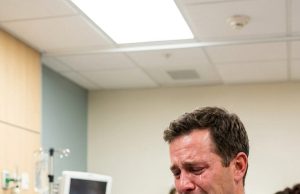
Amalia stroked the empty space on her knee where Oto had been resting. A small gesture, almost unconscious. Vicente didn’t move. His eyes flicked from Amalia to the dog and from the dog to the white rose she still held with both hands, and something in his face broke silently. He didn’t cry all at once. It was slower than that. His eyes stung first. Then his throat closed. He tried to swallow, but couldn’t.
He leaned forward, rested his elbows on his knees, and covered his mouth with his fist. Amalia didn’t see him, but she heard him. She reached out to where he was sitting and left her hand there on the damp wood of the bench without saying a word. Vicente didn’t take it, but he didn’t move either. Oto returned and sat down between them. Vicente wiped his eyes with the back of his hand, cleared his throat, and stared toward Independencia Avenue as if searching for something in the traffic.
Then he looked at Oto. The dog looked back at him, and Vicente decided something right then and there, without telling anyone, without making any announcement. That night, Vicente closed the cemetery on time. He turned off the lights, went out through the main gate, but before leaving, he stood for a moment looking at the north section. The next day, Vicente arrived at the cemetery 20 minutes early, separated a white rose from the Mondragón family’s arrangement, and left it near the side gate on the ground, without tying it to anything, so that Oto could take it without having to steal it.
At 5:02 PM, Oto went in through his usual entrance, found her, and continued on his way. Did this story touch your heart? Tell us in the comments what moved you the most. And if you know someone who understands that an animal’s love is incomparable, share this video with them. They’ll surely feel it too. Before you go, please like and subscribe to the channel. You’re helping us reach our goal of 1,000 subscribers, and every bit of support means a lot. Thank you for joining us this far. See you in the next one!