My name is Claire Donovan, and for three years I was trapped in a marriage that appeared flawless to everyone else—but behind closed doors, it was decaying. My husband, Ethan, hadn’t always been this way. He used to be polished, successful, dependable. But after we relocated to a quiet suburb outside Chicago, something inside him changed. He blamed stress, late nights at work, the alcohol—said those were the causes. As if explanations could soften the pain of bruises.
At first, it was just shouting. Then came the shoving. Then the slaps. Before long, violence became routine, like his only way to vent the rage he couldn’t control. Each morning, I learned to hide the evidence with foundation, long sleeves, and forced smiles. At work, I told familiar lies—I’d bumped into a door, slipped in the kitchen, overdone it at the gym. Deception became second nature.
Then one evening, after an argument over something insignificant—burnt pasta—he hit me with more force than ever before. My vision blurred. Darkness swallowed everything.
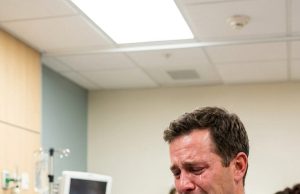
When I came to, harsh fluorescent lights glared down at me as a nurse adjusted the IV in my arm. Ethan sat stiffly in the corner, his face carefully arranged to look concerned.
“She fell down the stairs,” he told the doctor quickly, before I could say a word.
Dr. Marcus Hall didn’t really acknowledge him. His attention stayed fixed on me, thoughtful and quiet in a way that felt deliberate. He asked whether I’d had any “previous accidents,” his voice measured. Ethan stood close beside the bed, his hand resting on my shoulder—not comforting, but claiming. Warning.
Then the doctor suddenly stilled. His gaze locked onto something behind my ear. Gently, he moved a strand of my hair aside, exposing the bruise shaped unmistakably like fingerprints. His face changed—only slightly, but enough. He understood.
“Claire,” he said calmly, “would you mind if I spoke with you alone for a moment?”
Ethan’s body tensed. “Is that really necessary?”
Dr. Hall didn’t answer him. His eyes never left mine. And within that brief, heavy silence, the life I’d spent years hiding began to fracture.
The air in the room felt suffocating. Ethan’s grip tightened. The doctor’s patience wore thin. And deep down, I felt it—something was about to shatter.
That was the instant everything shifted.
The nurse stepped in, clearly sensing the tension. “Sir, we need to take Claire for a brief procedure. You’ll have to wait outside.”
It wasn’t true—but it was exactly what we needed. Ethan paused, his jaw locking tight, but after a moment he stepped into the hallway, casting one final searching look at me before the door closed.
The atmosphere changed immediately.
Dr. Hall pulled up a chair next to my bed. “Claire,” he said gently, “your injuries don’t match the explanation your husband gave. And these don’t appear to be isolated. I need to ask you—are you safe at home?”
The question broke through everything I’d been holding back. Tears came first. Words refused to form. The fear, the shame, the years of silence tangled in my throat. He didn’t rush me. He waited quietly, giving me space to breathe.
At last, I whispered, “No. I’m not.”
The words were small—but freeing. Like the first crack in a locked cage. Dr. Hall nodded, calm and steady. He explained the hospital’s procedures for suspected abuse, the legal options, the resources, the protection available. He reminded me I wasn’t facing this alone.
“I can’t,” I murmured. “If he knows I told someone—”
“You’re not alone in that fear,” he said. “But there are ways to protect you.”
The nurse returned with a folder—reports, photos, referrals. A victim advocate was already on the way. Safety plans. Emergency contacts. It was overwhelming, but it was also hope in paper form.
Minutes later, Ethan tried to force his way back inside, demanding answers. This time, security stopped him. Dr. Hall met him at the door.
“Mr. Donovan, your wife is still under evaluation. You’ll need to remain in the waiting area.”
“You can’t just keep my wife from me!” he shouted.
Dr. Hall didn’t flinch. “She’s my patient. Her safety comes first.”
The door closed again, muting his anger. For the first time, the storm wasn’t directed at me. I let out an unsteady breath. My hands still shook—but now from something new.
Hope.
Moments later, the advocate arrived. Her name was Rachel. She sat beside me, handed me tissues, spoke gently—like I was a person, not just a case file.
“Claire,” she said, “whatever you decide, you won’t face it alone.”
For the first time, I believed those words.
The next hours unfolded slowly, carefully—like a quiet rescue. Rachel explained every option without pressure: shelter, protective orders, reports, counseling, financial planning. Every step was terrifying. Every step was also a doorway.
“I don’t know where to go,” I admitted.
“You don’t need every answer today,” she said. “Only the next right step.”
And the next right step meant not going back.
The hospital arranged a discreet exit through a side hallway. Security walked with me. Rachel stayed close. My entire life fit into one small tote bag—phone, wallet, borrowed clothes. Yet somehow, that bag felt like freedom instead of loss.
Before I left, Dr. Hall checked on me one last time. “Claire,” he said, “what you did today was brave. This is the beginning.”
My throat tightened. “Thank you… for seeing me.”
“Always,” he said.
That night, in a quiet shelter room with clean sheets and soft light, I lay awake replaying everything. I expected guilt. Fear. Regret. Instead, a strange calm settled in.
I wasn’t healed. But I wasn’t invisible anymore.
The following days blurred into paperwork, meetings, and phone calls. Every difficult task felt like a stitch pulling my life back together. I filed for protection. I began counseling. I finally told my sister the truth—and she cried.
“You can come stay with me anytime,” she said without hesitation.
Slowly, the shape of a future began to form.
One afternoon at the shelter, as I filled out forms, a realization hit me: This wasn’t just a story of escape.
It was a story of beginning.
And maybe someone else needed to hear that beginning too.
So if you’re reading this—whether it reflects your own life or someone you care about—remember this: the moment you speak your truth, your world can change.
And if this story stirred something in you, reminded you of someone, or made you pause—
share your thoughts, your reflections, your experiences.
Stories connect people. And your voice might be the one that helps someone take their own next right step.